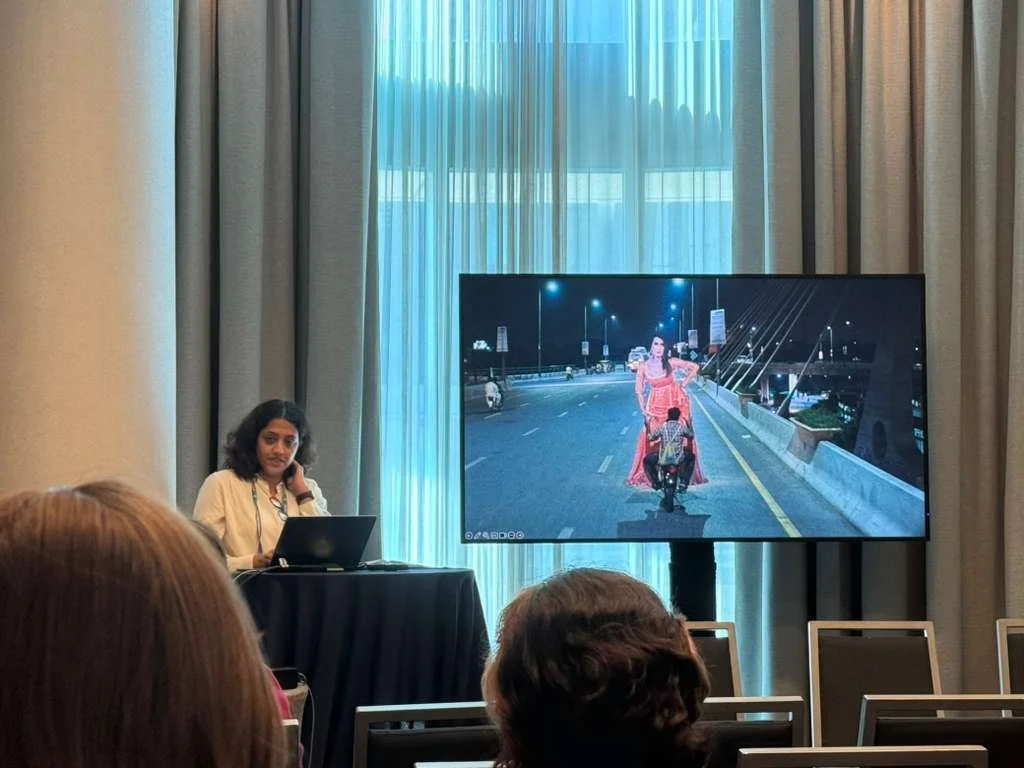
PAMLA 2025, San Francisco, California.
My first book project, Comparative Unpleasantness: Global South Asian Critique and the Dynamics of Minoritarian Feelings, contends that in order to grasp the promises and failures of postcolonial nationalism and neocolonial globalisation in the context of South Asia, we must study how negative emotions and their manifestations shape and fracture cultural practices, political formations, and social milieus. Expanding this premise, the monograph examines the workings of agitation, envy, vengeance, melancholia, mourning, debilitation, exhaustion, apathy, and hope in twenty-first-century literary depictions of the gendered legacies of the 1947 and 1971 Partitions, civil wars and occupations, environmental catastrophes and industrial disasters, the Global War on Terror and its fallout, and multilingual coexistence in postcolonial South Asia and its diasporas. By “unpleasantness,” I refer to a constellation of physiological, psychological, and emotional responses of a range of minoritized subjects who experience, bear witness to, and at times participate in complex cycles of violence. I bridge the gap between what Sianne Ngai calls “situations of passivity” and postcolonial eruptions to argue that novelists such as Tahmima Anam, Anuk Arudpragasam, Nadeem Aslam, Sharon Bala, Mohammed Hanif, Arundhati Roy, Indra Sinha, Mirza Waheed, and Gemini Wahhaj mobilize the ambiguities and contingencies of unpleasantness to reveal the continuum between everyday violence and extraordinary violence.
My research has been supported by: University of South Dakota’s College of Arts & Sciences, and UMass Amherst’s World Studies Interdisciplinary Project-Decolonial Global Studies Mellon Summer Dissertation Fellowship, Research Enhancement and Leadership Fellowship, College of Humanities and Fine Arts Summer Dissertation Fellowship, and Interdisciplinary Studies Institute Fellowship.